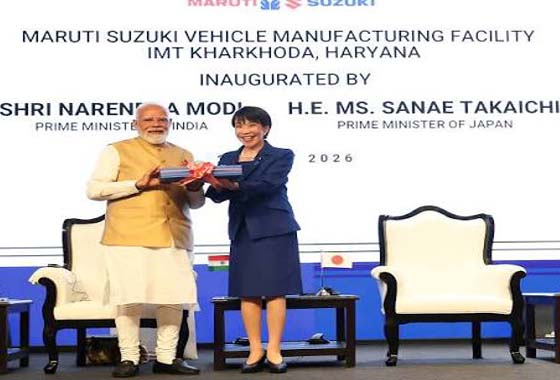
Prime Minister Narendra Modi and Japanese Prime Minister Sanae Takaichi inaugurated Maruti Suzuki India plant through video conferencing
New Delhi: Prime Minister Narendra Modi and Japanese Prime Minister Sanae Takaichi inaugurated Maruti Suzuki India plant on Thursday through video conferencing during the India-Japan Joint Economic Forum in New Delhi.
Maruti Suzuki India inaugurated its most advanced vehicle manufacturing facility at IMT Kharkhoda in Haryana. The integrated manufacturing complex spread across 800 acres. The Kharkhoda facility has been built on Suzuki’s Smart Factory concept incorporating Industry 5.0 technologies to improve safety, quality and productivity. This plant has been developed with an adjoining supplier park and is designed to become one of the world’s largest vehicle manufacturing facilities when fully operational.
Japan Prime Minister Toshihiro Suzuki said the project a landmark for the Suzuki Group. It was an honour that the company’s most advanced manufacturing facility had been inaugurated by PM Modi and PM Takaichi. Expanding the plant from its current capacity of 5 lakh vehicles to 10 lakh vehicles annually would make it one of the largest automobile manufacturing facilities globally, he said.
Suzuki is accelerating investments, employment generation, exports and technology development in India under the favourable policy environment created by the PM Modi Government. He highlighted India’s growing importance within the Suzuki Group. Japan PM said that the company’s first battery electric vehicle, the e -VITARA, is being manufactured exclusively at Maruti Suzuki’s Gujarat plant for exports to 100 countries.
The inauguration marks another milestone in Maruti Suzuki’s more than four-decade journey in India and further reinforces the strategic economic partnership between India and Japan. At full capacity, the Kharkhoda plant will play a crucial role in Maruti Suzuki’s ambition to achieve an annual production capacity of four million vehicles.
The plant has started operations with an annual production capacity of 5 lakh vehicles, which will be doubled to 10 lakh units in the next phase. The company plans to invest a total of Rs 35,000 crore in the facility, which is expected to generate more than 21,000 jobs upon completion. The plant also integrates sustainable solutions such as solar power, biogas, battery energy storage systems and green energy procurement, with its entire electricity requirement to be met through renewable energy sources.